
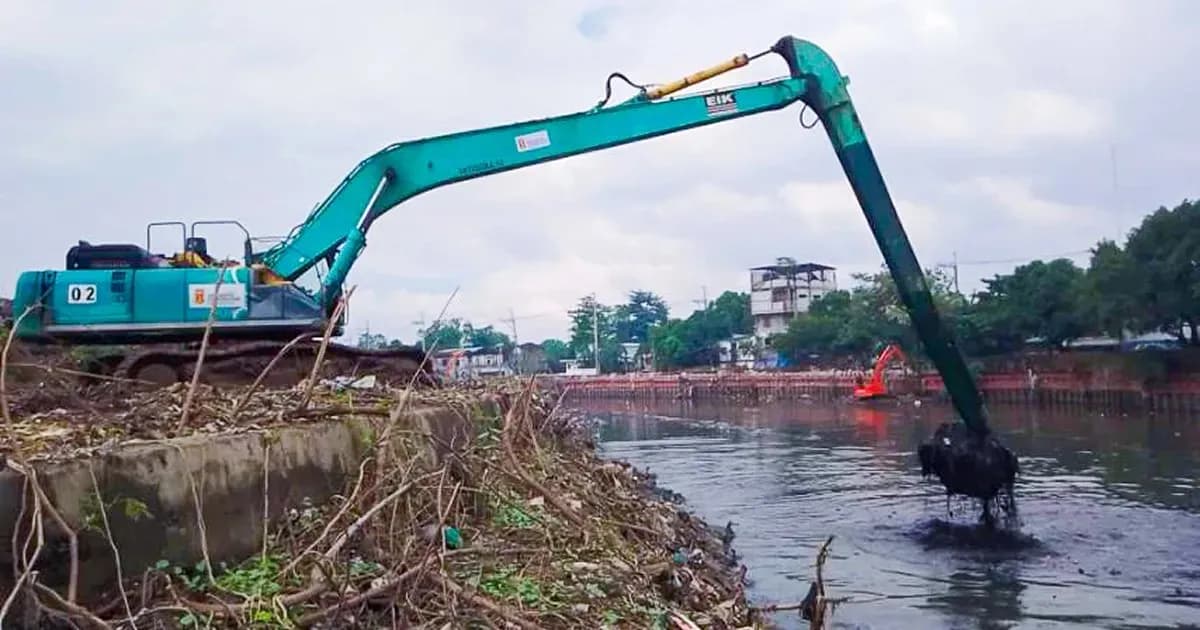
Every rainy season, floods bring Metro Manila and its neighboring provinces to a standstill. One of the causes is the state of the rivers themselves, which are clogged with silt and solid waste. A 2021 study cited by San Miguel Corporation (SMC) ranked the Pasig River as the world's top plastic-emitting river into the ocean, with the Tullahan and Meycauayan rivers also in the top five.
Since 2020, SMC, one of the country's largest conglomerates, has run what has become one of the biggest private river cleanup programs in the Philippines. Its scale is impressive. So is the debate it has drawn.
From one river to ten
The program began in February 2020, when SMC signed an Adopt-A-River agreement with the Department of Environment and Natural Resources (DENR) for the Tullahan-Tinajeros river system and pledged ₱1 billion. By the time it finished in August 2022, the company said it had removed more than 1.2 million metric tons of silt and waste from about 11 kilometers of the Tullahan River.
In 2021, SMC turned to the Pasig River, first earmarking ₱1 billion, then doubling the budget to ₱2 billion for a five-year plan. The Pasig cleanup passed one million metric tons by February 2023, and by July 2023 it had removed more than 1.31 million tons from over 21 kilometers, deepening some sections from 0.5–1.5 meters to 2.5–4 meters. By January 2024, the Pasig program was reported as completed.
The effort has since expanded to rivers in Bulacan and beyond. As of August 2026, SMC reported removing more than 9.38 million metric tons of waste and silt from over 204 kilometers of rivers, and had extended the program to Cebu.
A flood-control argument
SMC Chairman and CEO Ramon S. Ang has framed the program primarily as flood mitigation. "We are taking decisive action to clean up our major river systems to balance the needs of our economy and the environment," he said in 2021. In 2024, he said that since the Pasig and Tullahan cleanups were completed, communities had reported fewer floods and that "floodwaters still recede faster."
He has also been clear about its limits. "Cleaning up our rivers is a big help in mitigating floods, but it is not enough by itself," Ang said in August 2026. A DENR official made a similar point in 2025, warning that "without robust public policy, these gains may not be sustained."
The PAREX controversy
The cleanup has not been free of criticism. In 2021, Ang linked the Pasig River dredging to SMC's planned ₱95-billion Pasig River Expressway (PAREX), an elevated highway that would have run along the river. Environmental groups, heritage advocates and citizen coalitions opposed the project, arguing that it would undermine efforts to restore the river. In March 2024, SMC dropped PAREX, citing public pressure.
The episode showed how corporate environmental programs in the Philippines are increasingly judged not only by their outputs, but by how they connect to a company's wider business interests.
What it means
SMC's river cleanup demonstrates what a well-resourced private company can achieve in a short time on a problem that has defeated public agencies for decades. It also shows that lasting results depend on partnerships with government, on waste management upstream, and on public trust. For other companies considering large-scale environmental programs, the lesson is clear: scale matters, but so does transparency.